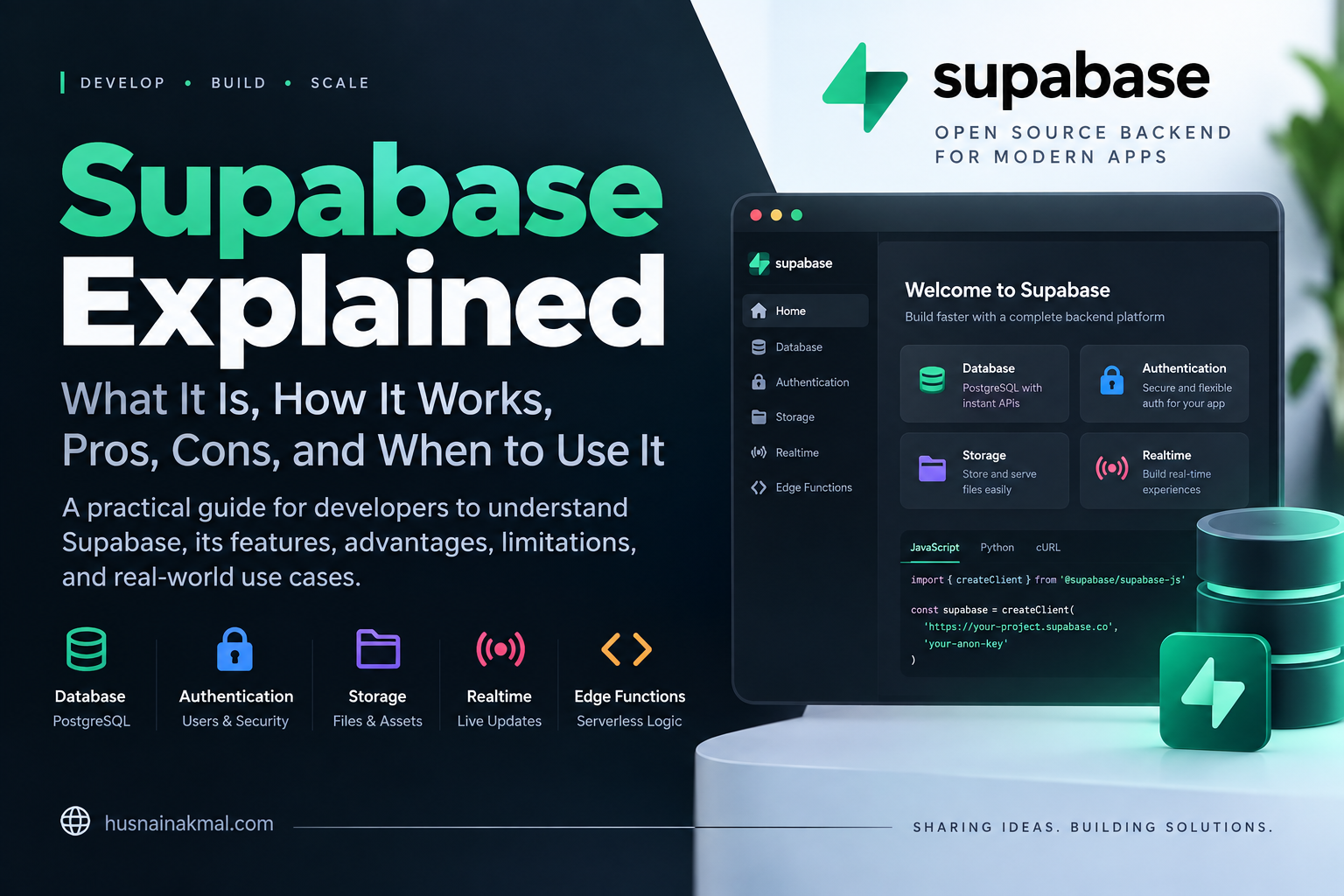
Supabase is a backend platform built around PostgreSQL, with authentication, storage, realtime features, APIs, and server-side functions included. It helps teams move from idea to working product without assembling every backend service from scratch. For developers who already understand relational databases, that combination can shorten setup time while keeping familiar SQL concepts.
This guide explains how Supabase works, where it fits, and where its convenience can create architectural trade-offs. I will cover the main features, practical use cases, advantages, limitations, security considerations, and a hybrid backend approach. The goal is to help you decide whether it is a good fit for an MVP, a SaaS product, or a larger production system.
Quick Takeaway
Supabase is strongest when you want managed PostgreSQL and common backend services without giving up SQL. It can reduce boilerplate, but schema design, Row Level Security, performance, and business-logic boundaries still need deliberate engineering.
What Is Supabase?
Supabase is an open-source backend platform centered on PostgreSQL. Each project includes a full Postgres database, while the surrounding services handle common application needs such as identity, files, realtime events, and APIs.
A useful mental model is “PostgreSQL plus the backend services most products need around it.” You still work with tables, relationships, indexes, constraints, SQL, and database functions instead of a proprietary data model.
- Database: managed PostgreSQL with SQL, extensions, relationships, and migrations.
- Authentication: email/password, passwordless options, social providers, JWT sessions, and SSO capabilities.
- Storage: object storage for application files with policy-based access control.
- Realtime: database change subscriptions, broadcast messaging, and presence.
- Edge Functions: server-side functions for custom logic and integrations.
- Data APIs: generated access to database data through APIs and client libraries.
How the Platform Works
PostgreSQL is the system of record, and the other services are connected around it. Your tables and constraints remain normal database objects, so the architecture can evolve with standard relational design practices.
The client can use generated APIs for straightforward data access, or a trusted backend can connect to the database for more complex workflows. That flexibility is important because not every product should expose the same level of database access to the browser.
1. PostgreSQL Is the Source of Truth
Model users, organizations, projects, subscriptions, invoices, and other entities with normal relational design. You can manage the schema through SQL, migrations, database tools, ORMs, or the dashboard.
2. Authentication Connects Identity to Authorization
Authenticated users receive JWT-based sessions that can be evaluated by PostgreSQL Row Level Security policies. This allows data access rules to sit close to the records they protect.
3. APIs Reduce Repetitive CRUD Code
Generated APIs and client libraries can handle many create, read, update, and delete operations. For simple product flows, this can remove a large amount of controller boilerplate.
4. Realtime and Storage Extend the Database
Realtime features can react to data changes or exchange events between clients, while Storage handles files and assets. Both are useful for dashboards, activity feeds, collaboration, and customer-facing portals.
5. Edge Functions Handle Privileged Logic
Payment webhooks, secret API calls, validation, third-party integrations, and privileged operations belong on the server side. Edge Functions provide one option, while a dedicated backend remains appropriate for larger domains.
Why Supabase Is Useful for Modern Apps
The main value is speed of delivery. A team can start with a database, authentication, storage, and application APIs already available instead of integrating separate services before building product features.
That can be especially valuable for an MVP or a small engineering team. The saved setup time can be spent on the product, while PostgreSQL still provides a mature foundation for relational data.
It also works well behind a custom Node.js, NestJS, Rails, Python, or other backend. That means you can start simple and introduce a stronger service layer when the business rules become more demanding.
Common Use Cases
Supabase is a natural fit for products where PostgreSQL is already a good data model and the team wants to avoid unnecessary infrastructure work. Typical examples include SaaS MVPs, internal tools, admin panels, customer portals, and mobile applications.
Realtime features make it useful for collaborative interfaces, notifications, presence, and activity feeds. It can also support AI products that need user accounts, application state, file storage, and structured data around an AI workflow.
- SaaS MVPs and startup products
- Admin dashboards and internal tools
- Customer and partner portals
- Mobile and web applications
- Realtime collaboration and notification features
- Content or community products
- AI applications with users, files, and structured application data
7 Advantages of Supabase
The strongest benefits come from combining a proven relational database with services that usually require separate setup. This can shorten delivery time without forcing a team to abandon SQL or normal database design.
The advantages are most meaningful when they remove undifferentiated infrastructure work. They should not be treated as a reason to skip security reviews, schema design, testing, or clear ownership of business logic.
1. Faster Product Development
Authentication, storage, APIs, and database tooling are available without building every component from zero. This reduces setup work and can help a small team validate a product sooner.
2. Real PostgreSQL Underneath
The database supports transactions, joins, constraints, indexes, JSON, functions, and extensions. You are not forced into a proprietary database model just because the surrounding services are managed.
3. Strong Data-Level Authorization
PostgreSQL Row Level Security can enforce which rows a user may read or change. This is valuable when browser clients access the Data API directly, because authorization is not left only to frontend code.
4. Integrated Authentication and Storage
Identity and object storage are already connected across the wider Supabase platform. That removes repetitive account, session, and file-management work from many projects.
5. Flexible Frontend Integration
Modern frameworks such as Nuxt, Vue, Next.js, React, Svelte, and Flutter can connect through official or community libraries. Teams can keep their preferred frontend while using managed backend services.
6. A Custom Backend Still Fits
Using Supabase does not require moving all business logic into the browser. A trusted Node.js, NestJS, Rails, or other service can own payments, workflows, integrations, background jobs, and privileged operations.
7. Open-Source Foundation
The open-source model gives teams visibility into the stack and a self-hosting path to evaluate when infrastructure requirements demand more control.
Limitations and Trade-Offs
Convenience can hide architectural decisions that eventually matter. The same feature that makes an MVP quick to build can create coupling if every new workflow is pushed directly into database access and policies.
The right question is not whether Supabase has limitations, because every stack does. The useful question is whether those trade-offs match the product’s complexity, security needs, traffic profile, and engineering team.
1. Direct Data Access Can Blur Architecture
A frontend can quickly accumulate direct calls to many tables. As the domain grows, rules may become scattered across UI code, policies, functions, and database logic, which can make change harder to reason about.
2. Row Level Security Requires Care
RLS is powerful, but missing or overly broad policies can expose data. Complex policies can also become difficult to debug, so teams need tests and a clear permission model.
3. Business Logic Can Outgrow a BaaS-First Design
Payments, multi-step transactions, orchestration, queues, and enterprise integrations usually benefit from a dedicated application layer. Keeping those rules in one service can improve maintainability and observability.
4. Hosted Services Still Create Dependency
Open source reduces some lock-in concerns, but the hosted product still has platform-specific configuration and operational behavior. Heavy use of proprietary service features can make a future migration more involved.
5. Scaling Still Needs Database Engineering
Managed infrastructure does not remove query tuning, indexes, connection management, data growth, caching, or RLS performance. A growing system still needs measurement and capacity planning.
6. Cost Changes With Usage
Production cost depends on database resources, storage, egress, authentication, functions, backups, and other usage. Teams should model those costs before a product reaches sustained traffic.
Managed Backend vs a Traditional Backend
A managed backend is usually faster at the beginning because common infrastructure is already available. A traditional backend takes more setup, but it gives the team a dedicated application layer from day one.
Neither approach is automatically better. The decision depends on how much domain logic exists, how quickly the team must ship, and how much operational control the system requires.
Decision Area | Managed BaaS | Traditional Backend |
|---|---|---|
Initial development | Usually faster | More setup and boilerplate |
Database | Managed PostgreSQL | Your chosen database and infrastructure |
Authentication | Built in | Built or integrated separately |
API layer | Generated APIs plus functions | Custom controllers and services |
Complex business logic | Can become distributed | Centralized application layer |
Operations | More infrastructure managed for you | More operational responsibility |
A Practical Hybrid Architecture
For many SaaS products, I prefer a hybrid model instead of treating the decision as “managed platform or custom backend.” The managed services handle infrastructure, while a dedicated application service owns the workflows that deserve stronger boundaries.
This approach keeps early development efficient and leaves room for the architecture to mature. It also aligns with the kind of backend and full-stack systems shown in my selected engineering projects.
- PostgreSQL for primary relational data
- Managed Auth for user identity and sessions
- Managed Storage for files and assets
- Node.js/NestJS or Ruby on Rails for payments, integrations, workflows, background jobs, and privileged operations
- Vue/Nuxt or React/Next.js for the frontend
This separation keeps sensitive business rules in a trusted layer while still benefiting from managed database and identity infrastructure.
When I Would Use It
I would choose this approach when the team needs to validate a product quickly and PostgreSQL is a strong fit for the domain. It is also attractive when authentication, file storage, CRUD APIs, and realtime features would otherwise consume a large part of the initial build.
Small teams can benefit most because fewer infrastructure components need separate setup and maintenance. A clear path to a dedicated backend should still be planned if domain complexity is likely to grow.
- The product needs an MVP quickly.
- Relational data fits PostgreSQL well.
- Authentication, storage, and CRUD APIs are core requirements.
- The team wants to minimize infrastructure work.
- Realtime dashboards, notifications, or collaboration matter.
- The architecture can evolve as complexity increases.
When I Would Not Use It as the Entire Backend
I would be cautious when the application has complex financial workflows, large amounts of domain logic, heavy background processing, or many enterprise integrations. Those systems often need a dedicated service layer for transactions, orchestration, auditability, and observability.
Supabase can still provide useful infrastructure in those cases. I would simply avoid making the browser and database policies responsible for every important business rule.
- Complex financial or transactional workflows
- Large domain models with many business rules
- Multiple asynchronous processing pipelines
- Mature microservice or strict service-boundary requirements
- Heavy external enterprise integrations
- Authorization that becomes difficult to maintain in RLS alone
- Special compliance or operational constraints
Practical Examples
Architecture choices become easier to judge when they are tied to real product shapes. The examples below show where managed services can remove setup work without forcing every business rule into the same layer.
In each case, the key is to separate ordinary data access from operations that require secrets, privileged permissions, or multi-step domain logic. That boundary is more important than whether the project begins with a BaaS or a custom API.
Example 1: SaaS MVP
A small SaaS team can use managed Postgres, Auth, and Storage while the frontend handles ordinary account and project screens. A lightweight backend can be added later for billing, webhooks, and workflow automation.
Example 2: Internal Operations Dashboard
An internal dashboard can store operational data in relational tables and use role-aware access policies. Realtime updates can refresh activity or status changes without building a separate websocket service.
Example 3: AI Product With User Data
An AI application can keep users, subscriptions, prompts, files, and generated records in structured storage. The AI provider call should remain server-side so secrets, billing rules, and validation stay outside the browser.
Security and Scaling Considerations
Security should start with least privilege. Exposed tables need carefully tested Row Level Security policies, privileged keys must stay on the server, and sensitive operations should not depend on frontend checks alone.
With Supabase, scaling still remains an engineering task. Query plans, indexes, connection limits, data growth, caching, and policy performance should be measured as traffic increases rather than assumed to be solved by the managed platform.
For teams building a dedicated service layer, my backend architecture and API work reflects the same principle: keep security and critical business behavior explicit, testable, and observable.
Frequently Asked Questions
These are the questions developers most often need answered before choosing a managed backend. The short answers are useful, but the architecture should still be judged against the product’s actual security and business requirements.
If a requirement changes the trust boundary, data model, or operational model, treat it as an architecture decision rather than a convenience setting. That mindset prevents early speed from turning into later technical debt.
Is Supabase a backend?
Yes. It combines a PostgreSQL database with authentication, storage, realtime capabilities, APIs, and server-side functions. It can be the primary backend for many products or infrastructure behind a custom service.
Is it only for small projects?
No. Production systems can use Supabase, but larger workloads still require database design, security testing, performance tuning, and operational planning.
Can I use Node.js or Ruby on Rails with it?
Yes. A trusted backend can connect to Postgres or use platform services while keeping business logic in Node.js, NestJS, Rails, or another application framework.
Is it secure?
Supabase provides strong building blocks such as authentication, roles, and PostgreSQL RLS. Security still depends on correct policy design, key handling, least privilege, and testing.
Should the frontend connect directly to the database APIs?
It can for carefully designed flows protected by strong RLS policies. Payments, secrets, privileged actions, complex workflows, and sensitive domain logic are usually better behind a server-side layer.
Final Thoughts
Supabase is useful because it packages common backend capabilities around a real PostgreSQL database. It can be an excellent choice for MVPs, SaaS products, dashboards, internal tools, and modern web or mobile applications when the trade-offs fit the product.
Supabase should not replace software architecture. Database design, security, access control, performance, application boundaries, and maintainability still need engineering judgment, and I would introduce a dedicated backend whenever the domain complexity justifies it.
I will continue covering practical backend architecture topics in the HusnainAkmal.com blog, with a focus on choices that help teams ship quickly without creating avoidable long-term complexity.
Official Documentation
For Supabase implementation details, use the official documentation as the source of truth because platform capabilities and configuration options can change. The links below cover the database, authentication, and Row Level Security topics discussed in this guide.
I recommend reading the security documentation before exposing application data directly to clients. The most important step is to understand the trust model and verify that policies match the intended permissions.
Comments are closed